selling
The Hidden Cost of Selling in Your DMs
“Just DM to order” feels free. It isn’t. Here’s what it’s actually costing Nigerian sellers, sale by sale.
Ask any seller running their business out of Instagram DMs how much it costs them to sell this way, and most will tell you: nothing. No subscription, no fees, no middleman. Just a phone, a following, and a "DM to order" in every caption.
They're wrong, and it's not their fault for thinking so. The cost of selling in your DMs doesn't show up on a receipt. It shows up as silence, the customer who never replied back, the sale that was almost made, the order that quietly died somewhere between "how much?" and "still there?" None of that gets counted anywhere. It just doesn't happen, and nobody notices the thing that didn't happen.
This is the part nobody puts a number on. So let's actually put some numbers on it.
The customer who asked and never came back
Picture the most common interaction in Nigerian social commerce: someone comments "price?" under a photo, or slides into the DMs with "is this available?" It feels like the start of a sale. Often, it's the end of one.
Here's why. That customer is, in that exact moment, as close to buying as they will ever be. They saw something, they liked it enough to ask, and they're waiting. Every minute that passes after that is a minute their attention drifts somewhere else, a notification, a different seller, a change of mind, dinner. If the seller is asleep, at work, or simply hasn't checked her phone in twenty minutes, that window can close entirely before she ever gets to reply.
Multiply that by every "price?" comment a seller gets in a week. Not every one was going to convert into a sale, of course, some were just curious. But some absolutely would have bought, right then, if buying had taken one tap instead of a wait. There is no line item for this loss. It never appears as a refund or a complaint. It just appears as a business that feels busier than it is profitable.
The sale that died at "send your account number"
Say the customer does stick around. Now comes the second cliff: payment.
"Send your account number" is one of the most fragile phrases in Nigerian commerce, because it asks a stranger to trust a person they've never met with real money, based on nothing but a chat thread and a profile picture. Some customers will do it without a second thought. Others will hesitate, ask a friend, decide it feels risky, and quietly close the conversation. A seller loses these customers not because her product wasn't good enough, but because the payment method itself introduced doubt at the exact moment trust mattered most.
And even when the transfer does happen, the seller isn't done. Now she's waiting too, staring at her bank app, refreshing, hoping the alert comes before the customer gets impatient and asks "did you receive it?" for the third time. Every one of these moments is friction that has nothing to do with the product and everything to do with the process wrapped around it. Good products lose to bad process more often than sellers realize.
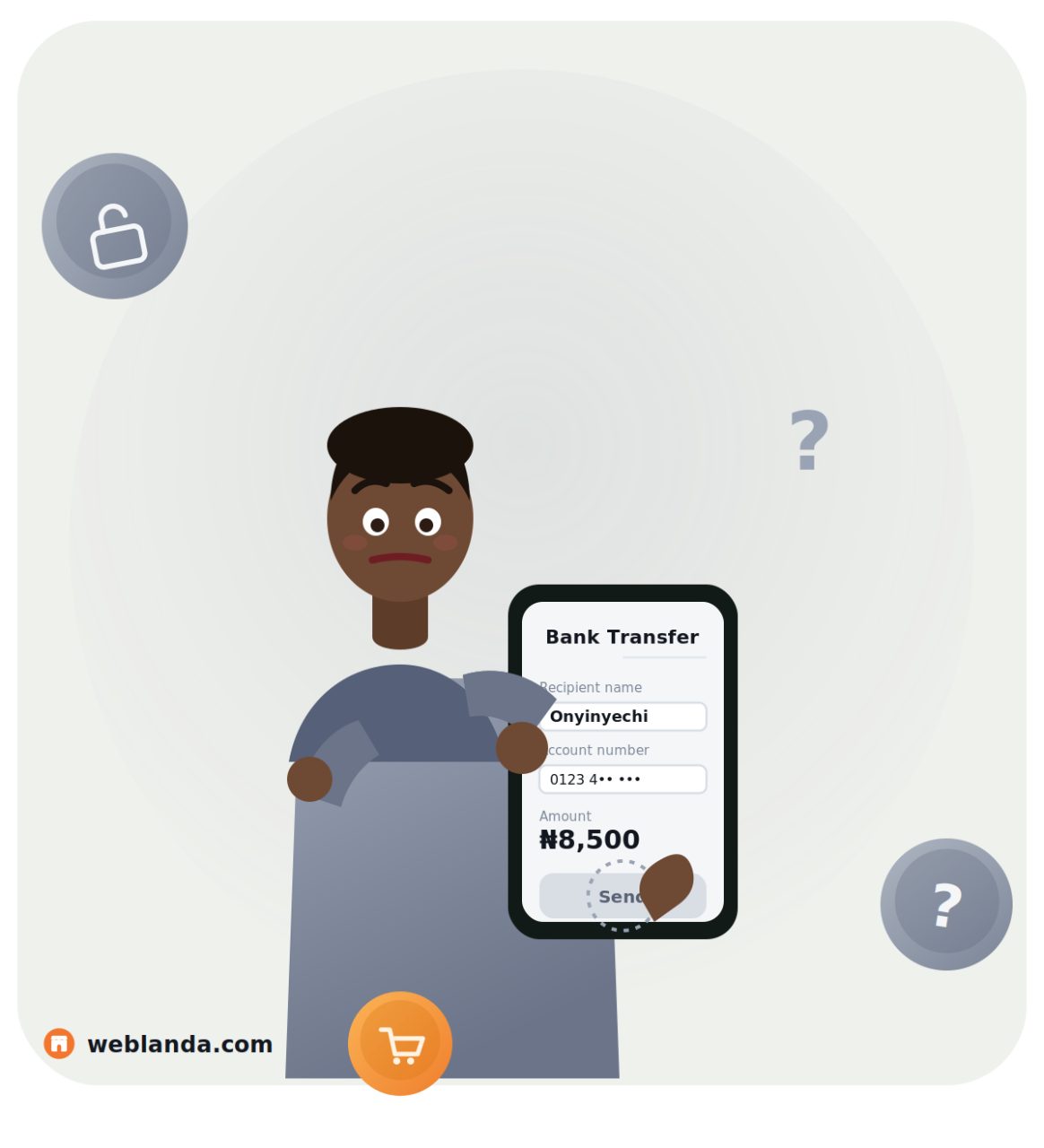
Here's a smaller cost, but it compounds. A seller running her business in DMs is also running her business without a memory. Where did that order for the blue dress go? Which customer wanted the size 40, not the 42? Did that transfer from Tuesday ever get matched to an order, or is it just sitting there unconfirmed?
Every one of these questions costs time to answer, and some of them never get answered at all, which means an order gets missed, a customer gets forgotten, or a product gets sent to the wrong person. None of this is a failure of effort. It's what happens when a business's entire operating system is a scrollable chat log, and a chat log was never built to be an operating system.
The catalogue nobody could actually see
There's one more cost, quieter than the rest: the customer who wanted to browse, not just buy one specific thing they saw in a single post. In a real shop, this customer wanders. She sees the dress she came for, and then she sees three more things she didn't know she wanted. In a DM thread, that browsing simply cannot happen. The seller would have to send photo after photo, one at a time, hoping the customer stays patient enough to ask for the next one. Most don't. The extra sale that a proper catalogue would have made almost by accident never gets the chance to exist.
Add it up, and the "free" way of selling isn't free at all
None of these costs show up on a bank statement. That's exactly why they're so easy to miss and so expensive to ignore. A seller doing everything right, good products, real effort, genuine hustle, can still be quietly losing a meaningful share of her possible sales to nothing more than the mechanics of how she's selling. Not because she's doing anything wrong. Because DMs were built for conversation, not for commerce, and she's been asking them to do a job they were never designed for.
What actually closes these gaps
Every one of these costs traces back to the same root cause: too much distance between "the customer wants this" and "the customer has paid for this." Close that distance, and most of what's been quietly leaking away stops leaking.
That's the entire idea behind a real shop. One link a customer can open and see everything at once, instead of asking for photo after photo. A checkout that takes payment right there, so trust isn't riding on an account number typed into a chat. An order that's recorded automatically the moment it's paid for, so nothing gets lost in a scroll. Delivery that's booked and tracked without another back-and-forth about "when will it reach."
This is what Weblanda actually replaces, not the relationship a seller has built with her customers on Instagram or WhatsApp, that stays exactly as it is, but the fragile, leaky process that used to sit between "I want this" and "I've paid for this." The conversation still happens. It just ends with a link instead of an account number, and the link does the part that a chat thread never could.
The real cost was never the fees. It was the silence.
Sellers worry about the cost of tools, a subscription, a percentage, a fee somewhere in the fine print. That worry is reasonable. But it's worth weighing against the cost that's already being paid every single day, invisibly, in the customers who asked and never came back, the transfers that made someone hesitate, the orders that got lost, the extra sale that never had the chance to happen.
Selling in your DMs was never free. It only felt that way because nobody was keeping score.